A few months ago I was watching KiyoshiWJ make a save in a fangame she was working on. The save involved having to play an entire screen with a timer running and if it ran out you died, a pretty standard trope in fangames. TheJPEGDemon was watching her make the save and when Kiyoshi mentioned potentially making the timer more lenient, Theo brought up the idea that if a timer in a fangame isn’t tight then they don’t really like it, since it isn’t contributing anything to the save really. Timed sections and speedrun challenges are pretty common in games, but there was always something strange about them to me in fangames. I think the issues I have with them personally are rooted in the basic movement of fangames, and the way more conventional types of level design translate into games where you are so limited in how you can move.
I think when you play fangames long enough you stop thinking about the fundamental details about them as much. Fangames are extremely rigid. There’s no input buffering (outside of abusing left/right priority), there’s nothing like coyote time to correct your inputs, and there’s no horizontal acceleration. The Kid responds to the things you do incredibly precisely, for better or for worse. When you consider other modern precision platformers (at least the conventional ones I’m aware of, I’m sure there are games out there with similar movement systems I’m just not aware of), you can find many examples of games with a high level of difficulty that kill the player in one hit, but still have all of these omissions included. The End is Nigh is a pretty well known game which has a very simplistic movement system, but there’s still a greater level of fluidity than fangames possess. The main character of that game also has more movement options by virtue of being able to hang onto any ledge and jump off with high speed. The Kid doesn’t have stuff like that. The Kid is only allowed to do something beyond walking and jumping when a gimmick is introduced, whether it be mainstays like water, vines, and platforms, or whatever novel ideas people come up with.
The implications of this limited movement is that what makes fangame platforming fun is often very different from what may be appealing about other platformers. There’s not much flashy about fangame movement, but it is very satisfying. The Kid being “rigid” as I put it allows for unusually precise gameplay. Needle games are incredibly dense with 1-2 frame windows even at an intermediate level because The Kid’s movement is so controllable that players can reliably do things this precise even without too much experience. This lack of variance in movement that makes The Kid so controllable however means that the skill expression in playing fangames quickly is rather limited. Most fangame speedruns boil down to “die less” and it’s not too often that the speed you play at is that relevant because there’s just not much to optimize there. This means on a save-by-save basis, where you can’t die regardless, timer based challenges present some unique issues.
Generally speaking, people who are good at fangames play faster than those who are not. However, this tends to be more of a personal choice than something indicative of their skill. I’ve heard of examples of players who play through needle very quickly because it makes it easier for them, and personally I’ve experienced the same thing. I play better when I’m going quickly and it can be hard to force myself to go slower. The natural speed at which a lot of people play needle is going to be somewhat close to the fastest a human could realistically do it. On the other hand though a lot of people also choose to play slower because that’s more comfortable to them, and there’s not much to motivate one to go really fast in a needle save. There’s not really any interesting tech to employ to go faster in most situations, it’s just personal preference in how you go about jumps.
These playstyle differences matter when there are situations in which a regular screen of platforming is timed. A good example is Floor 82 from Crimson Needle 3.
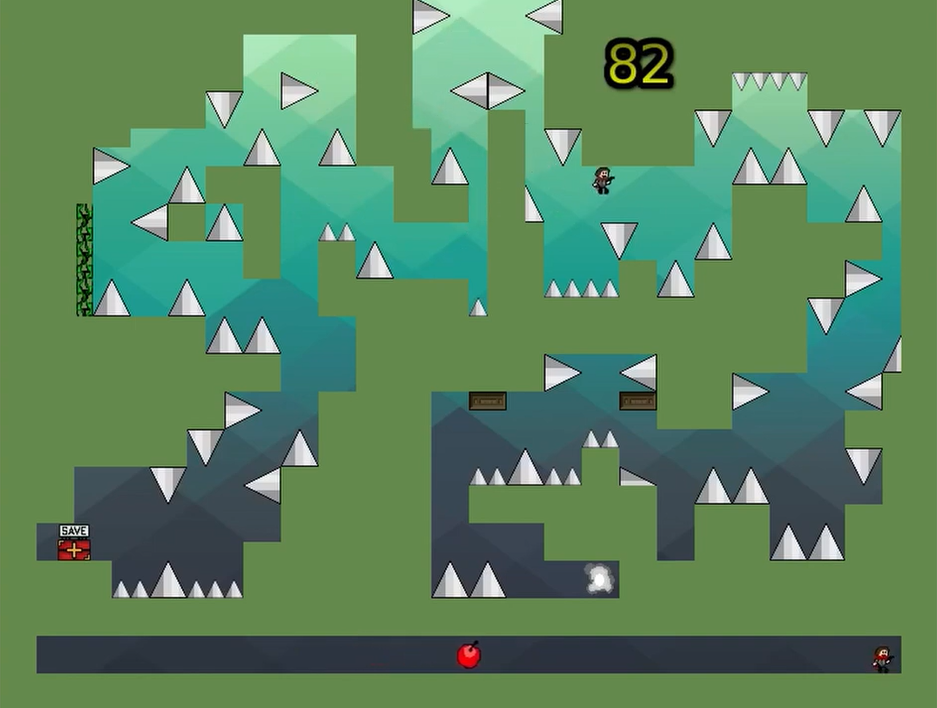
On paper a timed room like this is fine, but in practice these two groups of players can have a lackluster experience for different reasons. For someone who naturally plays fast the timer is unlikely to have any impact on the gameplay. I personally have played CN3 many times and have never run out of time in this room, I’ve never even thought about it. Conversely, someone who prefers to play slow is forced to play faster, but fangames lack compelling movement options that would make playing faster a more interesting or dynamic experience, so it might just feel bad. (Note that this is based on me observing people with this issue, I haven’t experienced it first-hand, nor do I think either of these gripes is applicable to every fangame player obviously.) I can’t attest to how the latter feels but the former is always a little disappointing whenever it comes up, since it leaves me with saves who’s major gimmick is something I’ll rarely ever get to properly interact with due to my playstyle.
This doesn’t mean that time-based challenges are entirely a bad idea in my opinion. My criticism here mostly applies to more standard platforming. There are a lot of unusual situations (even without the use of gimmicks) in which a speedrun challenge can be engaging because it takes advantage of the types of optimizations you don’t get much use out of in fangames. A very basic example is this screen in Yellow Star.
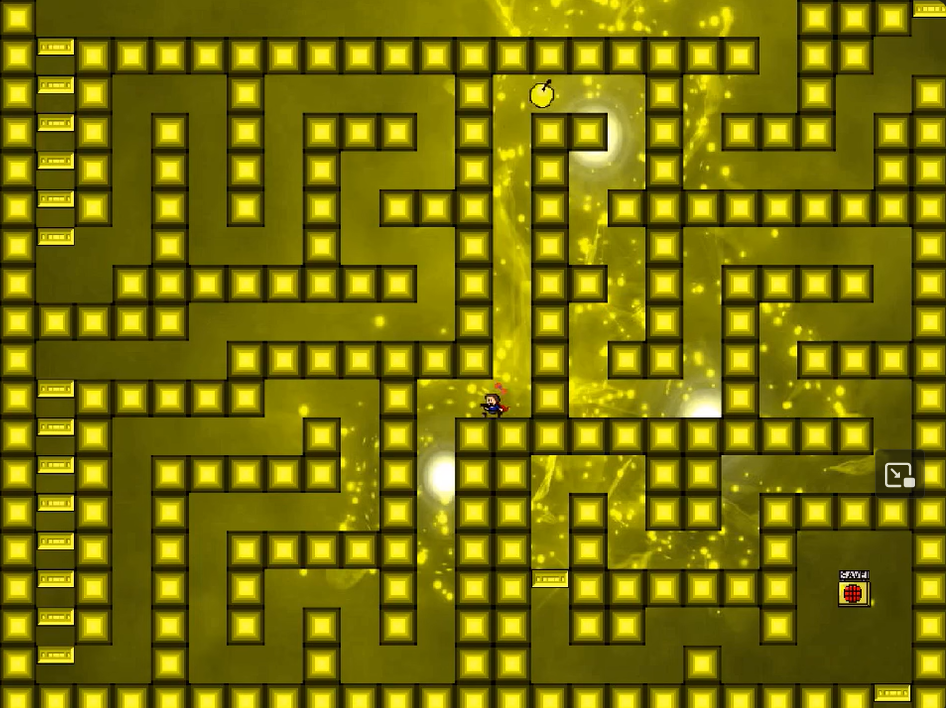
A lot of people are probably familiar with this from playing either the original game or more likely Kamilia 2 early on in their fangame journey. For a beginner player you’ll have to think about how to move faster in a game without a run button. It’s fun to try to cut corners by bonking on ceilings and optimizing how you climb up the blocks because you don’t get to do stuff like that very often. I truly believe this is a great room.
I Wanna Be The Noesis kinda has the grown-up version of some of these ideas. There’s a couple timed sections which hinge on small optimizations in climbing block structures, such as these sections in stages 2 and 5.
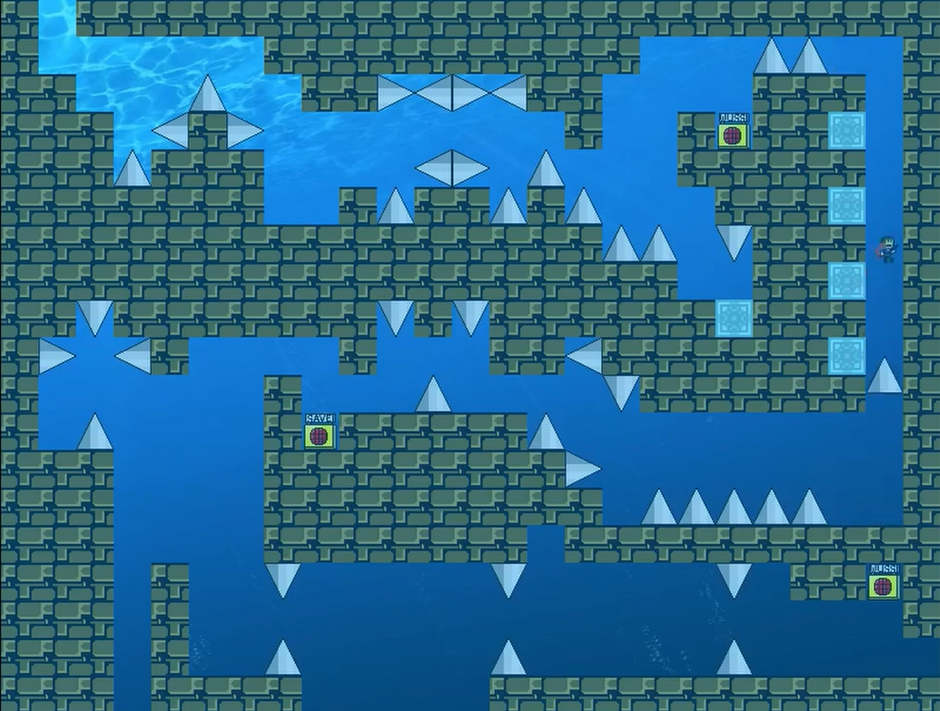
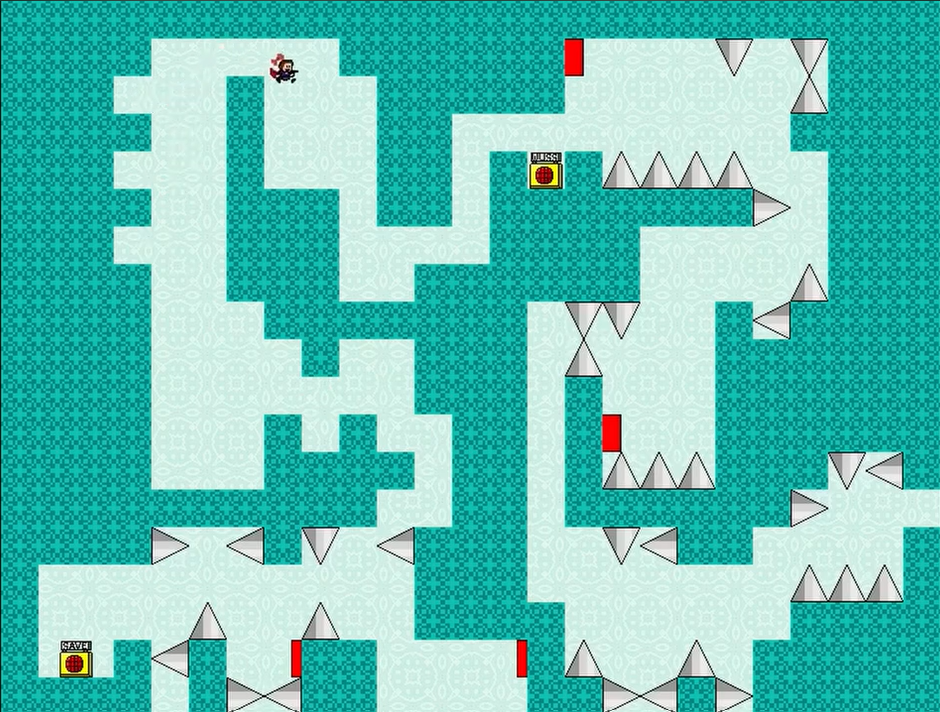
It’s a bit strange though, because there’s also this bizarre room in stage 5 as well
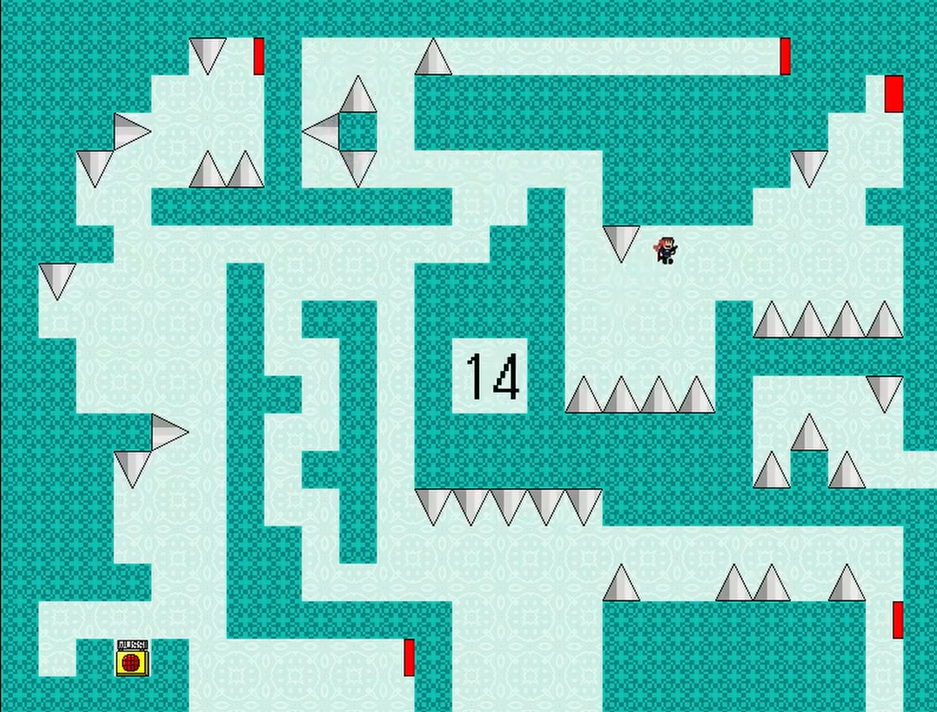
This timed room almost feels like the antithesis of a lot of the design of Noesis. The game is strict, it has a lot of tight triggers, tight cycles, it’s the kind of game where it feels like any mistake is going to be instantly punished. In a game like this there’s this super bizarre lenient timer which truly, doesn’t impact the gameplay, even if you are someone who likes to play slower the needle is at a low enough difficulty that there’s not really anything to incentivize taking your time. It makes for a very forgettable room but for me the fact the room is so unremarkable makes it memorable to me. It really exemplifies my point from before about how timers can easily be an entire aspect of a room the player just doesn’t engage with, and it’s why I think I agree with TheJPEGDemon’s point that started all this. When there’s not something novel to optimize, some kind of obstacle the player needs to really push themselves to do efficiently, a timer doesn’t really provide anything meaningful to the design of a room.
I Wanna Walk Out In The Morning Dew has a few more instances of a timed section being interesting because the optimizations you need to do are things that go beyond normal fangame play. They are pretty infamous in this game, especially the rocket one, although I think the vine climbing save is also really fun
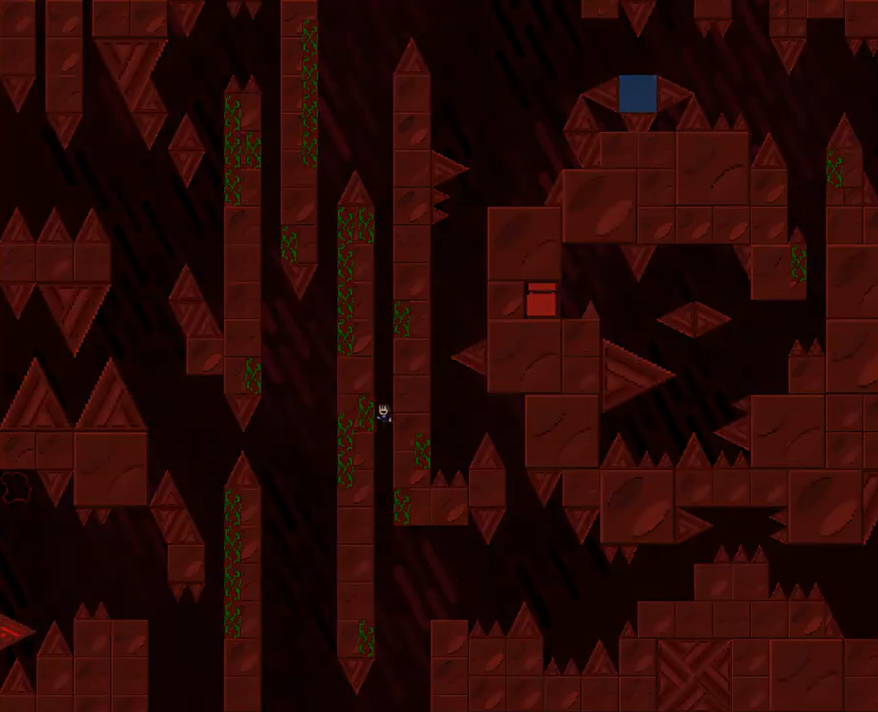

Vines are a pretty normal gimmick but the way you have to optimize how you get height by grabbing them quickly and instantly jumping off is a fun thing to improve at and get closer and closer to meeting the requirement. Likewise the rocket race is an even more extreme version, forgoing your normal moveset entirely and requiring the player to learn how to cut corners and manage their speed well. It’s maybe a bit outside the scope of this ramble because it’s not really related to “fangame movement” but it is movement that you do in a fangame. I think it’s noteworthy at least.
While I’ve focused mostly on timer based challenges so far I do think it’s worth mentioning that the unique movement in fangames can cause issues outside of this as well. I think for a while I assumed that playing fangames is inherently fun for me, and there might be some truth to that. I adore playing fangames and I love how they feel, but I think it’s hard to really appreciate what made them so fun for me until playing something that’s lacking those elements. When I played Delicious Level Design Contest I realized just how lacking The Kid’s movement was. I talked about this in my review for the game, how I found the stages designed in a more “normal video game” manner to be a lot less interesting because they ended up not having the thing that made fangames appealing to me. The Kid’s movement is so limited and slow that he really can’t do too much of note, so without the edge so many fangames have, whether it be in precise jumps, harsh learning curves, punishing gameplay, or whatever else, there wasn’t nearly as much there for me to really grasp onto and get hooked on.
The way fangames play is strange. It causes issues in a lot of areas. A lot of basic fangame jumps have extremely precise windows that most people would struggle to get consistent at, to the point they may feel random. The Kid is so slow and limited that not only can he barely do anything without the use of a gimmick, but it’s also shaped avoidance into an unusually luck based genre compared to almost any other hard video game niche. These things are not necessarily what most people would call “desirable” but I think they are extremely interesting. Fangames are really special games, and I think a lot of the reason I’ve stuck with them is because of how The Kid controls, and just how unique the games that have come out of his limitations are.